
School Labs
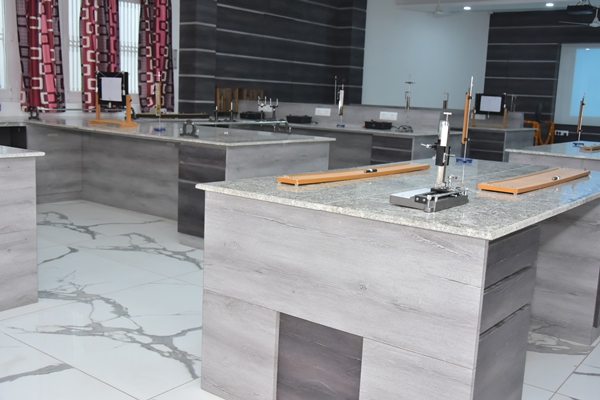
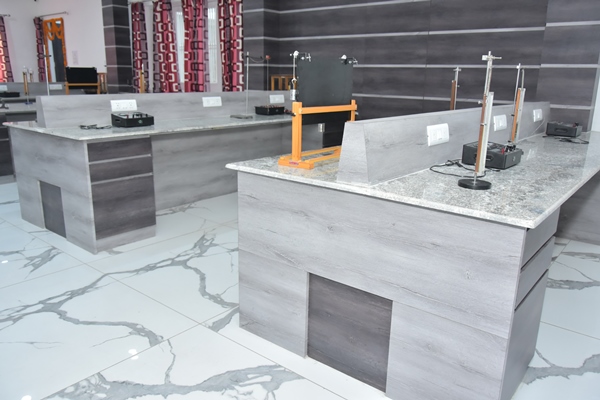

The Physics lab is updated & well-stocked in our school. We believe in raising the experimental abilities in each student. So let’s come together and explore the scientific thinking in each student.
“hamara vishwaas, har vidyarthi hai khaas”
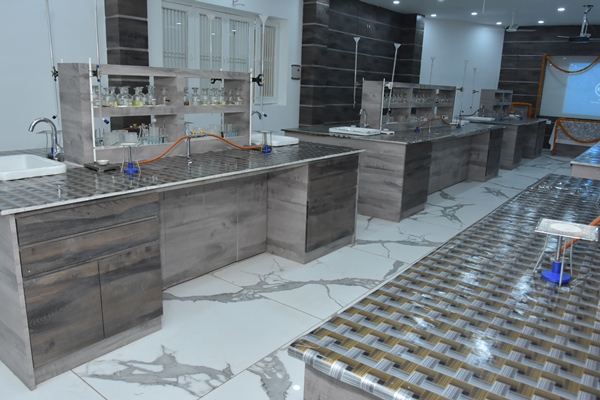
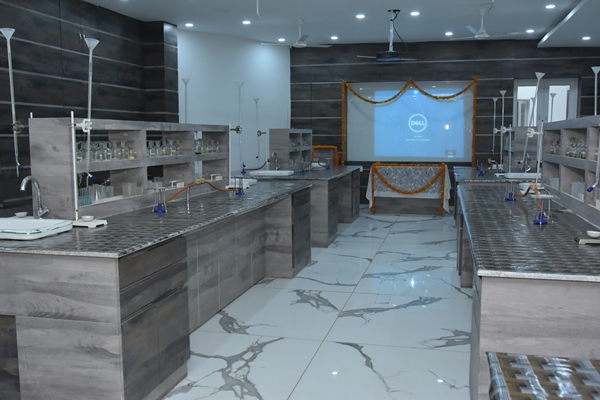
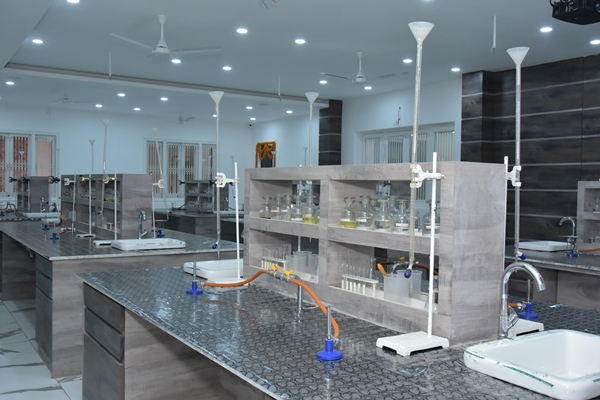
Keeping in tune with modern times, SARASWATI BAL MANDIR SCHOOL, HAPUR ensures that practical knowledge is placed on an equal footing with theoretical knowledge for the all-round development of the students. For this purpose, the school has laboratories in numerous disciplines, which provide in-depth knowledge to its pupils. The student-friendly atmosphere in these laboratories helps to enrich the overall personality of the students through motivation and reinforcement. In order to develop this scientific approach and to make learning Biology easy and interesting we have a neat, spacious, well ventilated and organized biology lab, which is supplied with the best equipments. It is very well equipped with maximum capacity of 30 students and an area with 39’5’ length’ and 24’10’’ width with 4 slabs. It is equipped with a projection microscope, overhead projector, oven, 3D models with charts and 2D framed models .Our Biology lab is a museum-cum-demonstration lab. It caters to the requirement of senior students. Keeping the latest syllabus in mind the models, microscopes, dissecting microscopes, dissection box, permanent slides, specimens, Human skeleton, charts, chemicals etc have been well planned.
Audio visual aids form an integral part of language learning process. The well-equipped language lab, with an expert, caters to the need of school children and provides them an appropriate atmosphere to learn the foreign language. It is equipped with multimedia control, wireless headsets and microphones to standardize pronunciation of the words generally found difficult. Here the students feel free to check and practice the pronunciation of as many words they like with the aid of cassettes, CD’s etc. The laboratory is designed to assist learners in acquiring and maintaining aural comprehension, speaking skills, written proficiency and cultural awareness. It takes special care to enrich and the language learning experience for every individual child. The electronic devices used in the laboratory help to stimulate eyes and ears to enhance the learning ability of the learner
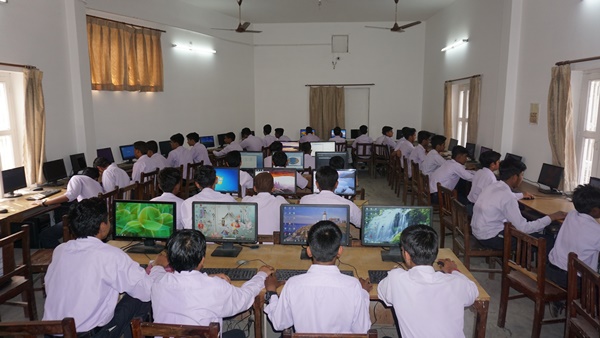
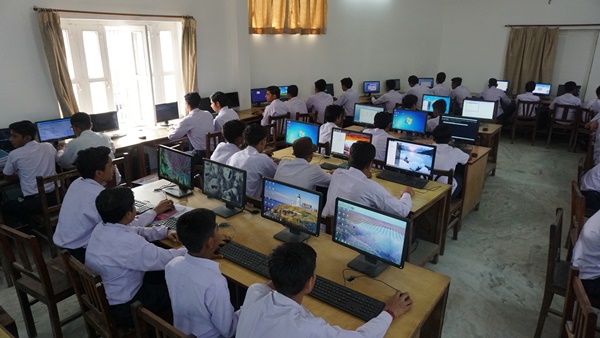
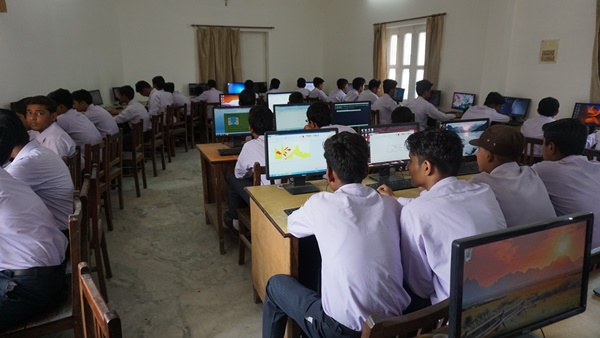
Technology plays a major role in twenty-first century education. The new model of integrating technology into the curriculum means that computers are on demand throughout the school day. Technology teachers and administrators face the task of developing a technology plan that makes the most effective and efficient use of the computer hardware available to them. Whether using desktops or laptops, Macs or PCs, the computer lab remains the center for most computing activity in schools. Saraswati Bal Mandir has well-equipped computer labs Well-qualified and efficient faculty is available. Each child has access to one computer making it 1:1 ratio currently. Investment in learning software is made which raise the schools contemporary standards of working with technology. Currently our Lab has 50 computers. To keep the classroom atmosphere comfortable and user friendly most of the monitors are 17” and 19” LCD which uses less power and hence generates less heat.
The social Science lab is setting under process, where about 30 models an illuminated globe, different types of apparatus like Aneroid Barometer, Wind Vane, Models showing day and night and Solar System, Thermometers, Laminated Maps and Charts are kept. All class from vi to x are taken to the lab. Students are made to undertake different types of activities related to Social Science like mapping, drawing, diagrams, timeline, group discussion etc.
The mathematics laboratory is a place where anybody can experiment and explore patterns and ideas. It is a place where one can find a collection of games, puzzles, and other teaching and learning material. The materials are meant to be used both by the students on their own and with their teacher to explore the world of mathematics, to discover, to learn and to develop an interest in mathematics. The activities create interest among students or in anybody who wants to explore, and test some of their ideas, beliefs about mathematics.
The activities in the Mathematics lab should be appealing to a wide range of people, of different ages and varying mathematical proficiency. While the initial appeal is broad-based, the level of engagement of different individuals may vary. The Mathematics lab activities listed here have been done with students and teachers of different grade levels. The activities are intended to give children an experience of doing mathematics and not merely for the purpose of demonstration.
The Mathematics lab provides an opportunity for the students to discover mathematics through doing. Many of the activities present a problem or a challenge, with the possibility of generating further challenges and problems. The activities help students to visualize, manipulate and reason. They provide opportunity to make conjectures and test them, and to generalize observed patterns. They create a context for students to attempt to prove their conjectures.
It is important to note that while in science experiments provide evidence for hypotheses or theories, this is not so in mathematics. Observed patterns can only suggest mathematical hypotheses and conjectures, not provide evidence to support them. (Sometimes, they may help to disprove a conjecture through a counter-example.) Mathematical truths are accepted only on the basis of proofs, and not through experiment.
Mathematics laboratory is a place to enjoy mathematics through informal exploration. It is a place where anyone can generate problems and struggle to get a answer. It is a space to explore and design new mathematical activities. So, the Mathematics lab should not be used to assess students’ knowledge of mathematics. Often mathematics lab takes students knowledge beyond the curriculum.
Mathematics laboratory is a self-explanatory lab with activities, in which students could come anytime (free to them) and engage in the work, continue working on the problems/tasks, and use teachers as and when they are stuck. In this way, the role of the teacher is not to teach how to progress in the activity but to facilitate inquiry with the mathematics in it. The facilitation could be done either by probing questions, giving an extra resource or asking to follow or discuss with peers.
Mathematics Laboratory Manual
In this report we have described some activities which could typically be included in a school mathematics laboratory. The activities are suitable for students of class 6 to class 10. We have also included a couple of activities suitable for a lower level — the place-value snake and the fraction chart. The items have been grouped under two broad headings: (i) activities and (ii) games and puzzles. The activities could be done individually by students, with guidance from a teacher, or could be used for demonstration with a small group of students. Some of the activities could also be used as teaching aids in a classroom. The games and puzzles are fun to do individually and all of them contain some element of mathematics which can be explored while doing them or as a sequel.
Preface
We, the human beings, are largely dependent on water for our survival. Although water is as important for survival of human beings as much as food, air etc. but we hardly pay any attention for its economical use and conservation of this precious resource. Due to indiscriminate pumping of ground water, the water table has already gone down abnormally and if we do not wake up even now then our future generations may have to face severe crisis of water. The rains are important source of water and if we can harvest rain water, the scarcity of water can be eliminated altogether. Therefore, it is our bounden duty to conserve the rain water in the form of rain water harvesting.
Need for rain water harvesting
Water is one of the most essential requirement for existence of living beings. Surface water and ground water are two major sources of water. Due to over population and higher usage levels of water in urban areas, water supply agencies are unable to cope up demand from surface sources like dams, reservoirs, rivers etc. This has led to digging of individual tube wells by house owners. Even water supply agencies have resorted to ground water sources by digging tube-wells in order to augment the water supply. Replenishment of ground water is drastically reduced due to paving of open areas. Indiscriminate exploitation of ground water results in lowering of water table rendering many bore-wells dry. To over come this situation bore wells are drilled to greater depths. This further lowers the water table and in some areas this leads to higher concentration of hazardous chemicals such as fluorides, nitrates and arsenic. In coastal areas like Chennai, over exploitation of ground water resulted in seawater intrusion thereby rendering ground water bodies saline. In rural areas also, government policies on subsidized power supply for agricultural pumps and piped water supply through bore wells are resulting into decline in ground water table. The solution to all these problems is to replenish ground water bodies with rain water by man made means.
- 1.5 Advantages of rain water harvesting
- (a) Promotes adequacy of underground water
- (b) Mitigates the effect of drought
- (c) Reduces soil erosion as surface run-off is reduced
- (d) Decreases load on storm water disposal system
- (e) Reduces flood hazards
- (f) Improves ground water quality / decreases salinity (by dilution)
- (g) Prevents ingress of sea water in subsurface aquifers in coastal areas 6
- (h) Improves ground water table, thus saving energy (to lift water)
- (i) The cost of recharging subsurface aquifer is lower than surface reservoirs
- (j) The subsurface aquifer also serves as storage and distribution system
- (k) No land is wasted for storage purpose and no population displacement is involved
- (l) Storing water underground is environment friendly
QUALITY OF WATER
The rain water is one of purest form of water and does not contain suspended / dissolved impurities. However when this water is collected through rain water harvesting, it gets contaminated because of contact with roof surface/ground and some of the impurities get mixed in it. These impurities are required to be removed before collecting the harvested rain water in storage tank or diverting it or recharging of ground water aquifers. Following precautions should be taken to ensure quality of water:
- 1. Roof over which water falls, should be cleaned before rain fall.
- 2. The suitable type of first flushing device to be installed and initial 10 to 15 minutes of runoff should be diverted.
- 3. The water collected from roof top only, should be stored in storage tank for direct use.
- 4. The runoff from surface/ground should be preferably be used for recharging ground water aquifers after proper filtration.
- 5. The rain water collected from roof top should pass through suitable type of filter and only then it should be stored in storage tank / used for recharging ground water aquifers.
The harvested rain water may contain some toxic substances which may affect our health. The water collected from roof top after filtration can be used directly for lawn watering, washing etc. But if this water has to be used directly for drinking purpose, then quality of water must be ascertained before use. The water used for drinking should comply with the provisions of IS-10500:1991 i.e. Indian Standard “DRINKING WATER – SPECIFICATION (First Revision)”. There is a rain water harvesting system in our school, that absorb the excess rain water to maintain the water level.